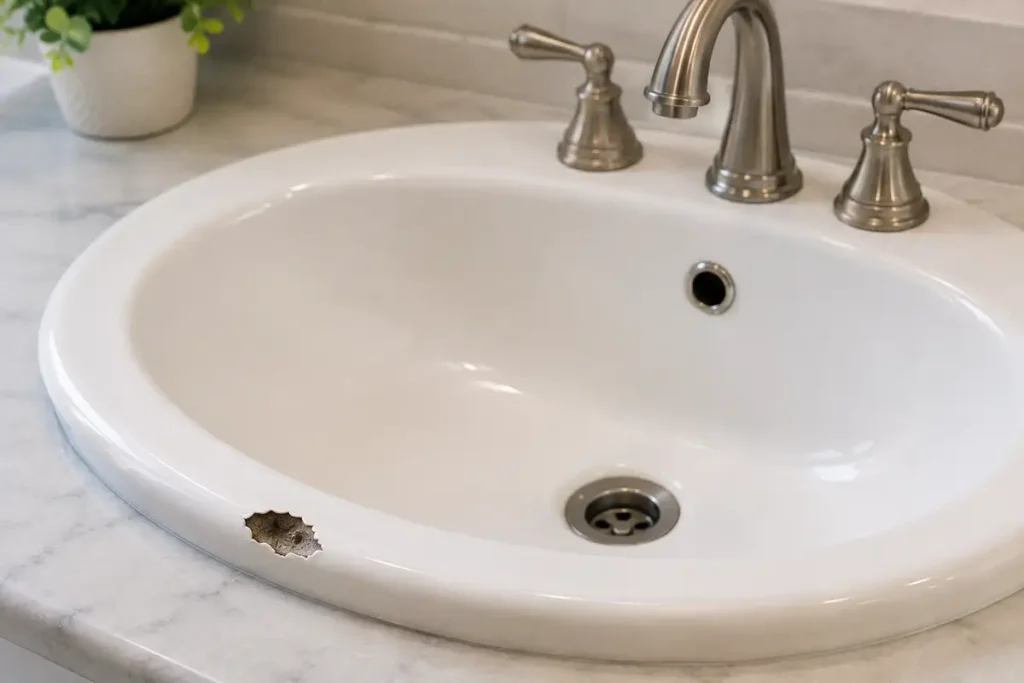
You can clean a chipped sink thoroughly and still feel that it looks dirty. The dark spot is not necessarily a stain: part of the finish may be missing, exposing the material underneath.
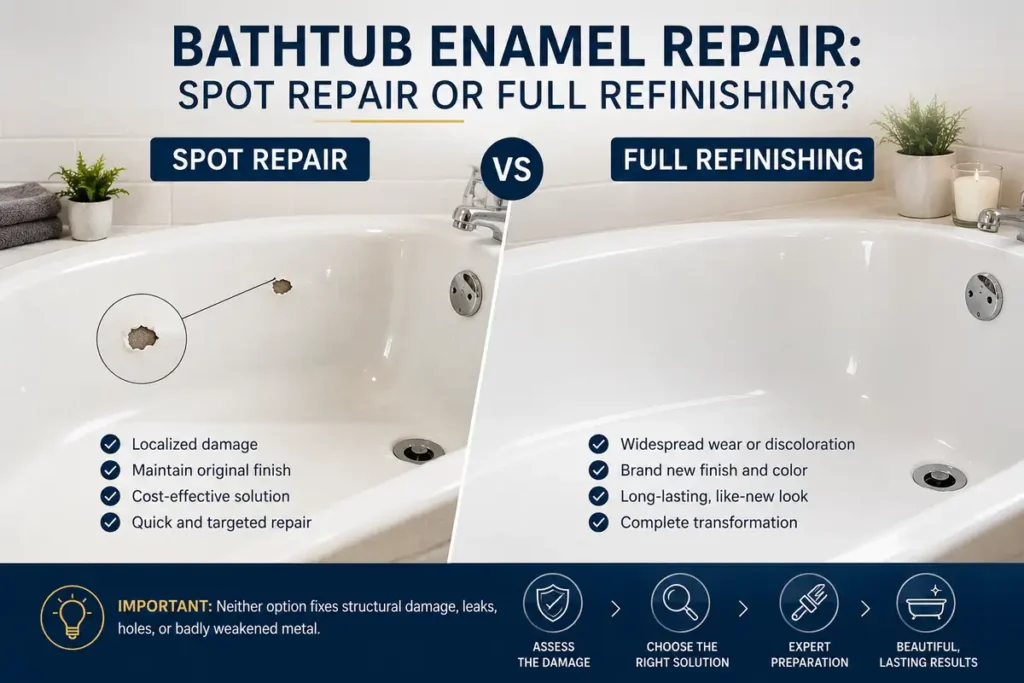
A chipped enamel sink can often be restored if the damage is localized and the basin remains sound. A spot repair rebuilds and finishes the damaged area. Full refinishing renews a wider surface. Neither should be used to disguise a leaking, fractured or badly deteriorated sink.
Before deciding to replace the fixture—or paint over the mark—work out which problem you actually have.
Is it a chip, a metal mark or a crack?
These defects can look similar in a quick photograph, but they do not call for the same treatment.
A chip means material is missing. You may see a small depression, an irregular edge or a contrasting layer beneath the glossy surface. Cleaning cannot put that material back.
A metal mark can sit on an intact finish. Kohler explains that cookware can leave marks on enameled cast iron that resemble scratches without penetrating the enamel. That calls for the appropriate cleaning method rather than automatically filling or repainting the area. Kohler’s enameled sink care guidance
A crack is a break that needs its depth and cause understood. A fine line is not automatically harmless because it is narrow. If the basin leaks or the crack passes through its body, cosmetic touch-up is not an adequate repair plan.
Look at the area in good light, but do not probe it with a sharp tool or run a finger over a broken edge. If you see moisture below the sink, its source could also be a drain connection or plumbing issue rather than the visible chip.
What is the sink made of?
“Porcelain sink” is often used loosely. For repair purposes, the construction matters more than the label in a shopping description.
| Construction | What the finish covers | What a chip can expose |
|---|---|---|
| Porcelain-enameled cast iron | A metal basin | Cast iron that needs protection from corrosion |
| Porcelain-enameled steel | A steel basin | Steel whose condition affects the repair |
| Glazed ceramic or vitreous china | A ceramic basin | Ceramic material; any deeper fracture needs assessment |
Porcelain enamel on metal is a fired glass-based finish, as the Porcelain Enamel Institute explains. A glazed ceramic sink has a different body, even when both fixtures are white and glossy.
A dark core can suggest exposed metal, but color alone is not a reliable identification test. Use the brand, model or a safely visible underside marking where available. Do not remove the sink simply to identify it.
Which chipped sinks are worth repairing?
The strongest candidates have a sound basin, a limited damaged area and secure surrounding finish. The rest of the sink still serves its purpose, and restoring the chip would solve the main complaint.
For example, imagine a bathroom sink that looks good apart from a small impact chip on its rim. Repairing the missing surface may achieve what you want without disturbing the countertop or plumbing.
Now imagine the same chip beside a drain with recurring leaks and deteriorated material around the opening. The visible blemish is only part of the problem. The drain connection and basin condition need attention before a cosmetic repair can be judged worthwhile.
On enameled metal, exposed iron or steel deserves prompt attention because it can rust. Loctite’s porcelain sink repair guide identifies this issue with chipped cast-iron sinks. That does not establish a fixed countdown until failure; it explains why covering the color without addressing the metal is incomplete.
How is a chipped enamel sink restored?
The work has two jobs: restore the missing shape and restore an appropriate finished surface. The depth of the chip determines how much of each is needed.
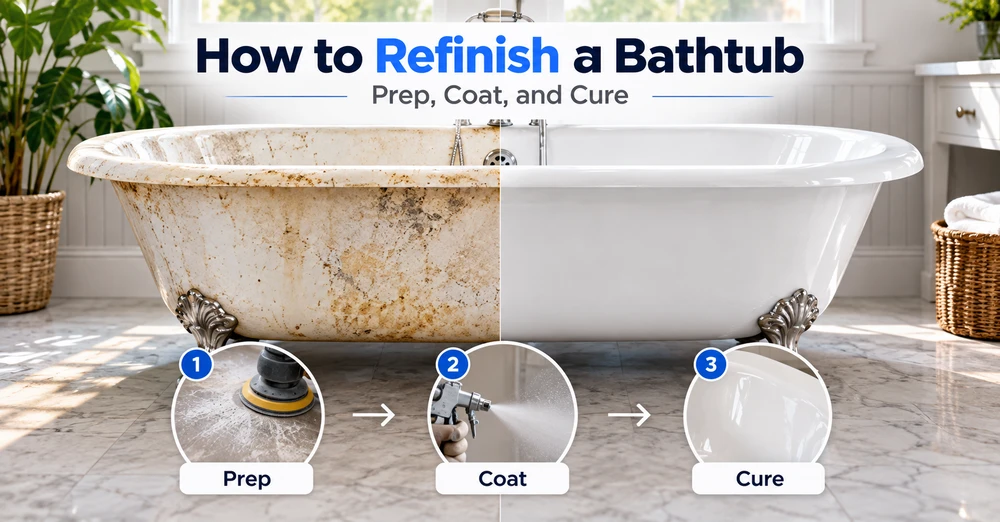
1. Prepare a sound base
The area needs to be free of residue and material that will not hold a repair. Soap film, oils, moisture and loose edges can interfere with adhesion. Where metal is exposed, corrosion becomes part of preparation rather than something to hide beneath the final color.
For a previously refinished sink, the condition and compatibility of that coating also matter. A new patch attached to a layer that is already lifting is only as secure as that layer.
2. Rebuild the missing depth
A chip is sometimes more than a thin break in color. A deeper cavity needs an appropriate filler so the repaired area can return to the surrounding curve.
Fixture-Fix’s Porc-A-Fix instructions, for example, distinguish the touch-up glaze from the filler it recommends for deeper chips. That is a useful distinction when evaluating kits: a color coating does not automatically do a filler’s job.
3. Level the repair and restore the finish
The repair should follow the sink’s shape rather than leave a raised blob or an obvious depression. A suitable color and finish are then applied as required by the repair system.
Color is only part of the match. The shine, surface texture and transition at the edge also affect whether the repair catches your eye each time you wash your hands.
4. Allow the complete system to cure
Application time is not the same as readiness for water. Follow the instructions for the filler and finish being used, including the required conditions and waiting periods. A surface that feels dry can still be unready for normal service.
Spot repair, full refinishing or replacement?
Choose a spot-repair assessment when the chip is the main problem. The surrounding finish is acceptable, you like the current color and the basin remains sound. The aim is to improve one defect while preserving most of the existing surface.
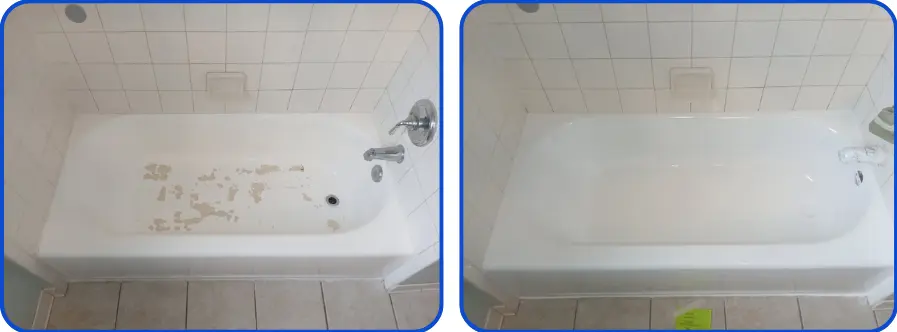
Consider full refinishing when the whole finish needs attention. A small repair cannot renew a broadly worn bowl, resolve widespread coating failure or change the sink’s overall color. Preparing and refinishing the larger area may give a more consistent result.
Consider replacement when the fixture cannot be made reliably sound or no longer suits the room. Fractures through the basin, extensive deterioration and unresolved installation problems can change the economics. Replacement may also make sense if you already plan to change the vanity or sink configuration.
Compare complete scopes. Keeping a suitable existing sink avoids removal, but a complex repair is not automatically economical. Replacing a basin can involve drain work, mounting changes and countertop compatibility as well as buying the new fixture.
Can you repair the chip yourself?
A small cosmetic defect can be a reasonable DIY project when the product explicitly covers the sink material, the damage and the intended use. Confidence in identifying those three things matters more than how easy a short video makes the application look.
Some kits have important exclusions. CRAMER’s Repair-Kit is intended for minor damage and chipping but excludes hairline cracks. “Sink repair” on the packaging does not mean every type of sink damage is covered.
For a visible rim, an unusual color, rust, previous coating failure or uncertain crack depth, professional assessment may be the more practical starting point. Do not improvise color adjustments, solvents or mixing ratios from unrelated products. Follow the chosen product’s safety and ventilation instructions as well as its application directions.
Kitchen sinks need an extra check
An enamel repair suitable for a bathroom basin is not automatically suitable for a kitchen sink. Cookware, cleaning routines, hot-water exposure and possible food contact affect the demands on the repaired area.
Product restrictions can be quite specific. Fixture-Fix states that Porc-A-Fix is not food-safe and must not be used on items that may hold food for consumption. Do not assume a repair paint is appropriate for food-related use because it is sold for porcelain surfaces.
Multi-Tech likewise discusses cast-iron sink restoration as a situation needing individual evaluation, particularly for kitchen sinks. Establish the exact coating’s suitability and the intended use before selecting the repair. This article’s bathroom-restoration advice is not a blanket recommendation to refinish every kitchen basin.
What should the finished repair look like?
A good repair should restore a smooth, usable contour and improve the appearance of the damaged area. Whether it disappears completely depends on the existing color, gloss, wear and lighting.
White is not one universal shade. CRAMER notes that sanitary colors are not standardized in the same way as common color-reference systems. Manufacturer and model information can therefore help with color selection, particularly for older fixtures.
If a small visible blend would bother you, make that expectation clear before deciding on a localized repair. A wider refinish and a spot repair are different appearance choices, not simply different prices for the same result.
Protect the restored surface
Use the care routine specified for the repair rather than assuming the original sink’s cleaning instructions still apply unchanged. Avoid abrasive scrubbing of the patch and keep heavy glass containers away from edges where they can fall into the bowl.
Be careful with generic advice to add a rubber sink mat. Kohler specifically advises against rubber dish mats in its enameled sinks because of possible discoloration beneath them. Choose accessories compatible with the fixture and any applied finish.
If the repair lifts or discoloration returns, photograph the change before applying another product. The cause matters more than hiding it again.
Enamel sink repair FAQs
Can the sink stay installed during repair?
Some localized surface repairs can be completed in place. Drain-area damage, mounting problems or poor access can require additional work, so the visible chip does not define the entire job.
Will refinishing replace the original factory enamel?
In-home refinishing applies a new coating to the existing fixture. It does not reproduce the factory firing process or change the material of the basin underneath.
Restore a chipped bathroom sink in Jacksonville
Bath Tub Man offers bathroom sink refinishing in Jacksonville and Northeast Florida. For a quote, send a close-up of the damage and a photograph of the whole sink, with any known material or repair history. Call 904-744-3999 or use the quote form to discuss whether surface restoration fits your sink.