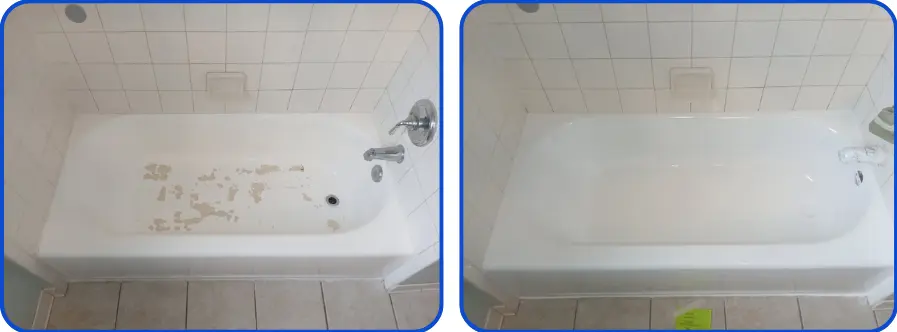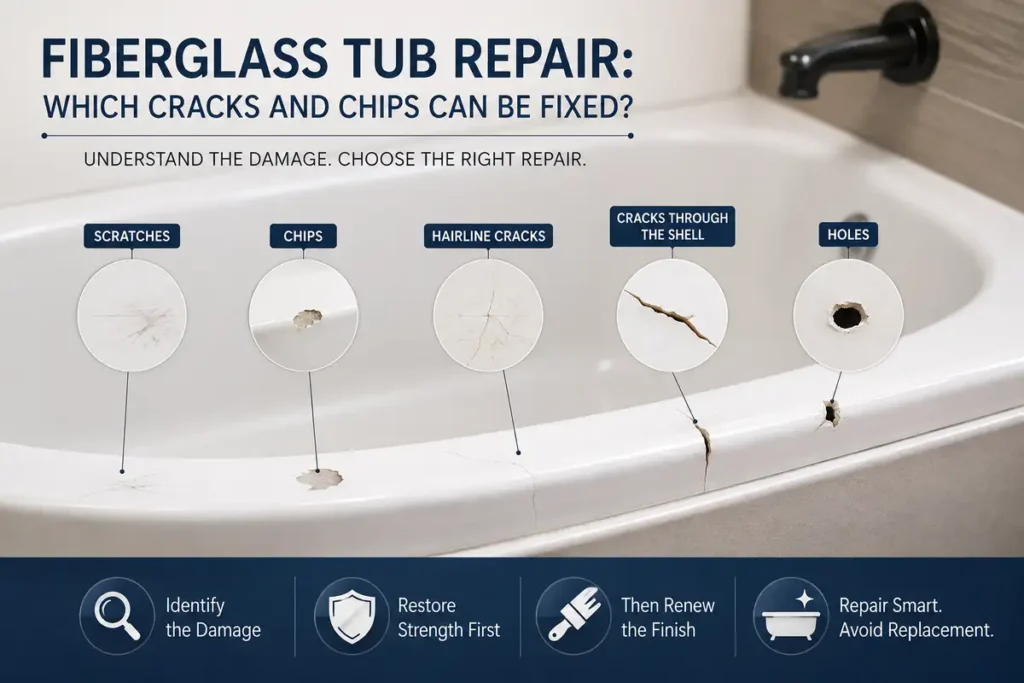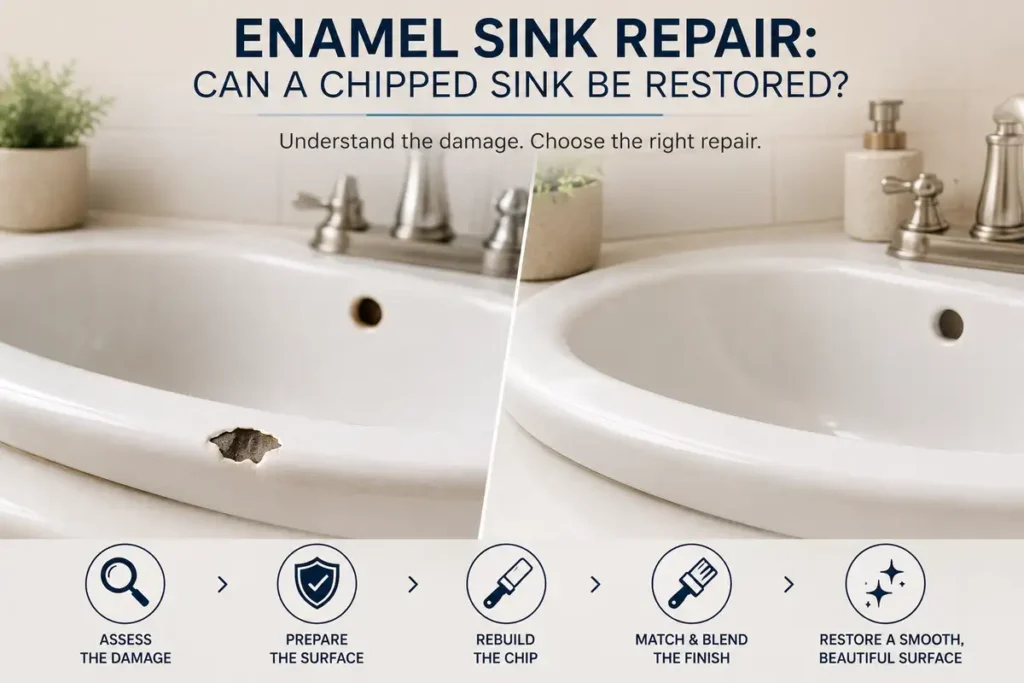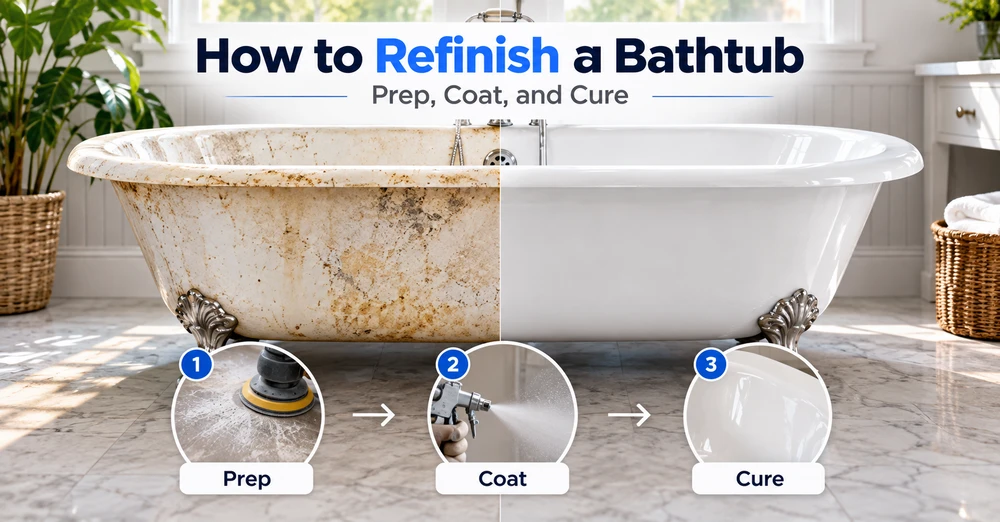
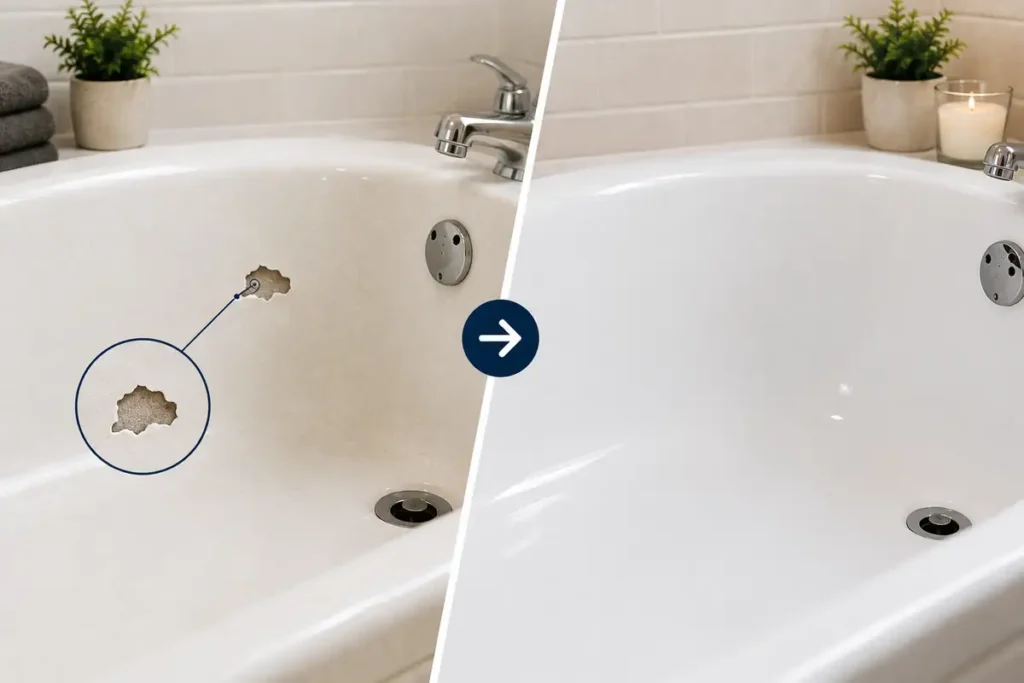
One chipped spot does not necessarily justify coating an entire bathtub. Equally, fixing that spot will not do much for a basin that is dull, rough and peeling everywhere else.
Spot repair makes sense when the damage is localized and the surrounding finish is worth keeping. Full refinishing makes sense when the tub is sound but the finish needs attention across a wider area. A leak, a hole or badly weakened metal introduces a separate question: whether the fixture itself can be restored safely.
The most useful place to start is the surface around the chip—not the number of repair products on a hardware-store shelf.
What are you repairing: original enamel or a later coating?
On a porcelain-enameled cast-iron or steel tub, the original finish is glass bonded to metal at high temperature. That is how the Porcelain Enamel Institute describes the material.
An in-home repair uses an applied material to restore the damaged area. Full refinishing prepares the existing surface and applies a new coating over the agreed area. Neither process fires new factory enamel onto the tub inside your bathroom.
This distinction explains why “enamel repair,” “reglazing” and “refinishing” can cause confusion. They may appear together in service descriptions, but a small touch-up and a complete new coating involve different scopes of work.
Previous refinishing matters too. A missing piece of the original enamel and a lifting layer of an older applied coating may look similar in a photograph. Their causes—and the preparation needed—can be different.
When is spot repair the better fit?
A good candidate has a limited defect and a sound surrounding finish. Perhaps something fell against the tub wall, leaving a chip, while the rest of the bathtub still looks and feels satisfactory.
The repair aims to fill the missing area, restore its contour and blend the finish. Most of the original surface stays untouched. That can be a sensible choice when you like the tub’s existing color and gloss and do not need a wider refresh.
The location influences the appearance of the result. A small repair directly beneath a bright bathroom light may stand out more than one tucked against the far wall. Older whites also vary: a patch can be smooth and functional without disappearing under every lighting condition.
Several separate impact chips can still be candidates for localized work. There is no reliable rule that the third or fourth chip automatically requires full refinishing. Their depth, location and surrounding surface matter more than a simple count.
When does full refinishing make more sense?
Full refinishing becomes more attractive when improving one spot would leave most of the problem behind.
Examples include widespread surface wear, an unwanted color, several visually different old patches or an earlier coating that is failing across the tub. If the body is sound, refinishing can create a more consistent appearance over the prepared surface.
Chips and gouges still need preparation and repair before coating. A fresh finish does not automatically level a depression, remove rust or make loose material adhere. The wider coating is the finishing stage, not a replacement for the work underneath.
Also distinguish damage from removable buildup. Soap film, mineral deposits and transferred marks can make an intact finish look worse than it is. Appropriate cleaning may be the first step; repeatedly scrubbing with stronger products can create a second problem.
| Question | Spot repair | Full refinishing |
|---|---|---|
| How much surface changes? | The damaged area and its blend | The agreed wider surface, commonly the tub interior |
| What condition suits it? | Local damage with satisfactory surrounding finish | Broad finish problems on a sound fixture |
| What happens to the color? | It is matched as closely as practical | The coated area receives a consistent chosen color |
| What remains unchanged? | Most of the existing finish and its wear | The fixture’s shape, size and underlying condition |
| What can neither option ignore? | Structural problems, leaks and unsound material | Structural problems, leaks and unsound material |
Rust and peeling need different answers
A rusty chip: establish what is still sound
Where a chip exposes steel or iron, the metal’s condition becomes part of the repair. Covering orange discoloration without addressing corrosion can leave the reason for failure in place.
A small area of surface corrosion is not the same as metal that has deteriorated through. Likewise, a rust-colored stain does not by itself prove the tub body is corroding; the source needs to be identified.
The practical distinction is whether there is a sound base to restore. Full refinishing cannot replace metal that is no longer structurally adequate.
A peeling finish: repair the coating problem first
If a previous coating is lifting in several areas, patching each loose edge is unlikely to address the overall failure. The work needs a plan for removing failed material and preparing what remains.
Notice the difference between one impact chip in a firmly bonded coating and widespread peeling without an obvious impact. They should not automatically receive the same recommendation.
Do not pull at peeling edges or begin stripping the tub before the scope is agreed. That can enlarge the work area and obscure useful evidence about the existing finish.
What does the repair or refinishing process involve?
For a localized enamel repair, the main tasks are cleaning and preparing the defect, dealing with unsound material, rebuilding any missing depth, leveling the repair and applying a compatible finish.
Filler and touch-up color are not necessarily the same product. Fixture-Fix, for example, directs users to fill deep chips before applying its Porc-A-Fix touch-up glaze, which it identifies as a cosmetic touch-up product rather than a full refinishing system. A little bottle of color is not a universal answer to every gouge.
With full refinishing, the preparation extends across the area being coated. Nearby surfaces need protection, residues must be removed and existing defects must be addressed before the new finish is applied.
Bath Tub Man describes bathroom protection as part of its process, using masking and drop cloths around nearby fixtures and surfaces. That is useful work to include in a refinishing scope, even though it will not appear in the final photograph.
Three examples that make the choice clearer
Consider these hypothetical situations:
A glossy tub with one impact chip: Start with a spot-repair assessment. Refinishing the whole tub may add work without solving an additional problem.
A solid tub with a rough, worn basin and several old patches: A new patch could leave the overall appearance much the same. Repairing the defects and refinishing the wider surface may better match the homeowner’s goal.
A tub with a hole and recurring moisture beneath it: Neither a cosmetic patch nor a new coating is the first decision. The fixture and leak need investigation before choosing restoration or replacement.
These examples turn the question from “Which service is better?” into “Which service addresses what is wrong with this tub?”
Is spot repair always cheaper?
It usually involves a smaller area, but area alone does not determine the bill. Travel, setup, preparation, color matching and minimum service charges can all affect a localized job.
Full refinishing adds work across the tub. Removing an old coating or dealing with several failed repairs can add more. Comparing quotes therefore means comparing the preparation, repair and finish coverage—not just the final total.
If replacement is another option, include removal, plumbing and making good the surrounding bathroom. The price of a new tub on its own is not the price of an installed replacement.
A useful estimate should explain what could change after closer inspection, especially if corrosion or an earlier coating conceals the condition underneath.
How soon can you use the tub again?
Dry to the touch and ready for bathing are different stages. The return-to-use time belongs to the actual coating system and the conditions in which it was applied.
Bath Tub Man currently states that its reglazing typically dries in two to four hours and that fixtures can usually be used again after 24 hours. Treat that as its general service guidance; follow the instructions for your specific job. The company also publishes different warranty periods for residential and high-use rental properties, so confirm which terms apply. Bath Tub Man’s process and warranty information
Bathtub enamel repair FAQs
Can I use a repair kit on a hairline crack?
Do not assume a chip-repair product covers cracks. CRAMER’s Repair-Kit, for example, explicitly excludes hairline cracks. The defect and the product’s stated uses need to match.
Does reglazing make an old tub structurally stronger?
Reglazing renews the finish. It should not be treated as structural reinforcement for a weakened fixture or as a repair for a plumbing leak.
Should a repair be completely invisible?
A well-executed repair can blend closely, but shade, gloss, age and lighting affect visibility. Agree on the expected appearance before choosing localized repair over a wider refinish.
Choose the right scope for your Jacksonville bathtub
Bath Tub Man offers bathtub refinishing in Jacksonville and Northeast Florida. Call 904-744-3999 or request a quote with a close-up of the damage and a photograph of the whole tub. Include any previous refinishing history so the estimate can address the surface you actually have.